The data is clear. Destinations that stay visible thrive. Those that go dark fall behind.
The signs of a coming economic slowdown are hard to miss, and some analysts see a slump in the tourism sector as already underway. History tells us what usually follows. Policymakers will eye cuts to destination marketing budgets, using the familiar (but misguided) logic that if travelers are pulling back, why spend to promote? Some will argue that “people will come anyway,” so why spend money reminding them? In reality, cutting destination advertising during a downturn only deepens the slump and prolongs the economic recovery. At first glance, slashing budgets may seem appealing, but when we look at the data, the truth is clear, cutting advertising reduces visitor volume.
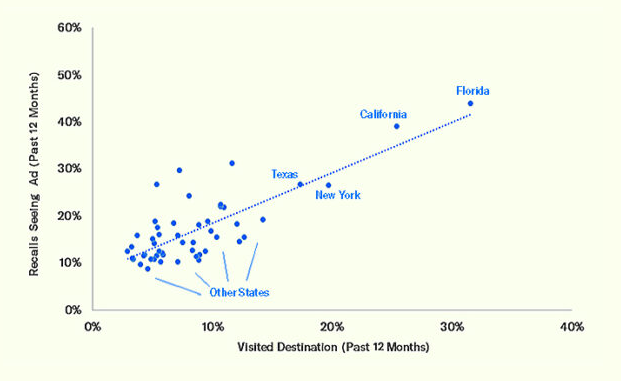
Our 2025 The State of the American Traveler Survey (32,215 total respondents) shows a strong relationship between advertising recall and likelihood to visit. Travelers are significantly more likely to plan a trip to places they remember seeing ads for.
Advertising Recall & Visited Destination (States):
Want visitors? Stay visible. The data makes it crystal clear. Advertising recall and intent to visit rise and fall together. In our state-level data we see the states most likely to be visited are strongly correlated with advertising recall.
- Florida: 44% ad recall, 60% likelihood to visit
- California: 40% recall, 53% likelihood
- New York: 27% recall, 49% likelihood
- Nevada: 31% recall, 46% likelihood
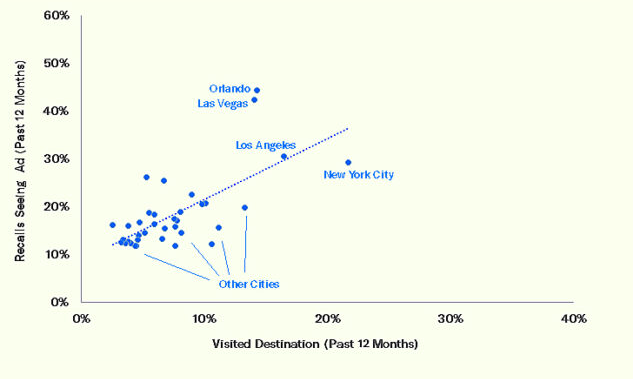
The pattern is too strong to ignore, and extends to urban destinations, as well. Across 52 major city destinations tracked in the study, the results are the same. The more advertisements travelers see from a destination, the more likely they’ll be to plan a visit.
Advertising Recall & Visited Destination (Cities):
The Power of Incremental Visitation
Here’s a nuance that policymakers often miss. Advertising doesn’t create all visitation but it absolutely creates some, and if done even moderately well, always injects more money into government coffers than is spent on the advertising. People travel for many reasons, family get togethers, events, bucket-list trips, but advertising is the trigger for a specific group of visitors who wouldn’t have come otherwise. In tourism research, we call this incremental visitation. These are the trips that only happen because an advertisement sparked action. And that incremental impact is what drives measurable ROI for destination marketing organizations.
Estimating Incremental Visitation
At Future Partners, we’ve built a reputation for taking a conservative, no-nonsense approach to estimating advertising ROI, and the numbers still come out big. In recent years, we’ve conducted a series of destination advertising ROI studies, and across all the communities studied, the results averaged an impressive
$47.02 in incremental visitor spending for every $1 invested in advertising. Even more compelling for policymakers, each dollar also generated
$3.05 in tax revenue. In plain terms, spend a buck on the typical destination advertising campaign, and on average you get forty-seven dollars flowing into local businesses and three dollars right back into government coffers.
Why Cutting Ads Costs Destinations
Beyond the direct financial returns, there are other reasons to keep investing in destination promotion.
- Lost competitive ground. In a noisy travel marketplace, disappearing from sight means losing share to states and cities that keep showing up in travelers’ feeds and screens.
- Long-term brand erosion. Even the strongest destinations maintain visibility because they know that once awareness slips, rebuilding it costs far more than sustaining it.
A Call to Defend Tourism Promotion
Advertising isn’t fluff; it’s fuel. Our data shows that recall and likelihood to visit move together, and that destination advertising delivers the incremental visitors destinations rely on for jobs, tax revenue, and growth. So yes, tourism ads work. Cutting them is a costly mistake no destination can afford to make.
If an economic slowdown takes hold, it will be tempting to view tourism marketing as expendable. But the opposite is true. Every dollar cut will only amplify recession-driven budget woes. Advertising is one of the few proven levers to generate incremental visitation, jobs, and tax revenue when demand softens. Policymakers and community leaders must resist the short-term urge to slash and instead defend their marketing dollars, because destinations that stay visible through downturns are the ones best positioned to recover quickly.
If you’re a policymaker, community leader, or tourism stakeholder, the message is simple, protect your destination’s marketing dollars. Advertising is not a luxury. It is an engine for incremental visitation that drives real economic returns. Every cut to advertising budgets creates fewer visitors, less local spending, and weaker tax revenues. The data is clear.
Destinations that stay visible thrive. Those that go dark fall behind.
Copyright 2025 Future Partners. All rights reserved. From https://futurepartners.com.